

Category:Manikgoanj District
Manikganj District (Template:Langx; Template:IPA) is a district in central Bangladesh and part of the Dhaka Division. It was established in 1845 as a subdivision of Faridpur District, then in 1953, it was transferred to Dhaka District for administrative purposes. Finally in 1984, Manikganj was declared a full district.
History
Template:More citations needed Manikganj subdivision was established in 1845.[1] It was transferred from Faridpur District to Dhaka District in 1853.[2] In 1984, Manikganj subdivision was promoted to a full district.[1]
War of Liberation
The liberation war in 1971 in Manikganj District was organized and led by Abdul Halim Chowdhury, Abdul Matin Chowdhury, Principal Abdur Rouf Khan, and other heroes of the district.
On 29 October 1971, at the northwest corner of Golaidanga village, the Baldhara union (a group of freedom fighters) in Singair Upazila attacked boats carrying intruding Pakistani soldiers and a terrible battle occurred on the Nuruni Ganga (canal of Kaliganga river). Eighty-one Pakistani soldiers were killed, and many others were injured. The operation was led by freedom fighter Engr Tobarak Hossain Ludu, commander of the Mukti Bahini Lodu group. None of the Mukti Bahini freedom fighters were killed during this battle, which was a significant liberation fight against the Pakistani military in Manikgonj.
After this short-duration battle, the Mukti Bahini freedom fighters left the battlefield, and the Pakistani ranks were reinforced with more soldiers. They burnt 160 houses surrounding the area of Golaidanga village and killed 9 local people who were primarily elderly and stayed at home. Some local young boys helped freedom fighters in that ambush.
After the Golaidanga fight, Singair Upazila became free from Pakistani occupation on 13 November 1971. In the last week of November 1971, fresh groups of freedom fighters entered different areas of Manikganj and defeated Pakistani troops in a few battles.
On 14 December 1971, a group of Pakistan Bahini moving toward Dhaka entered Barundi village in Manikganj Sadar Upazila. Meanwhile, a group of liberation forces (Mujib Bahini) under the leadership of Shahadat Hossain Biswas Badal was preparing to attack them within the suitable place. Understanding this, the Pakistani soldiers immediately left the village, leaving two soldiers behind. One of them was arrested by the liberation forces at night on 14 December 1971, and the other was arrested by the same group after a small fight the next day. The then sub-division was declared free on 13 December.
Daulatpur–Saturia tornado
On 26 April 1989, Manikganj was the site of the Daulatpur–Saturia tornado, which became the deadliest tornado in recorded history. 1,300 people were initially reported as having been killed, with 12,000 injured. The towns of Saturia and Manikganj were leveled, and about 80,000 people were made homeless.
Geography
Manikganj comprises an area of Template:Convert. Annual average temperatures reach a maximum of 36 °C and a minimum to 12.7 °C with the annual rainfall total being Template:Convert.
There are several rivers in the Manikganj District,[3] including the Padma River, Kaliganga River, Jamuna River, Dhaleshwari River, and Ichamati River.
Demographics
Template:Historical populations
According to the 2022 Census of Bangladesh, Manikganj District had 393,524 households and a population of 1,558,025 with an average 3.91 people per household. Among the population, 259,616 (16.66%) inhabitants were under 10 years of age. The population density was 1,126 people per km2. Manikganj District had a literacy rate (age 7 and over) of 71.17%, compared to the national average of 74.80%, and a sex ratio of 1072 females per 1000 males. Approximately, 14.74% of the population lived in urban areas. The ethnic population was 909.[4]
Religion
Manikganj District has 3,575 mosques, 160 temples, 10 churches, five Buddhist temples, and a pagoda. The Hindu population has fallen from nearly 150,000 in 1981 to 130,000 in 2011, but increased to 139,000 in 2022.
| Religion | 1941[5]Template:RpTemplate:Efn | 1981[6] | 1991[6] | 2001[6] | 2011[6] | 2022[7] | ||||||
|---|---|---|---|---|---|---|---|---|---|---|---|---|
| Template:Abbr | % | Template:Abbr | % | Template:Abbr | % | Template:Abbr | % | Template:Abbr | % | Template:Abbr | % | |
Islam 
|
419,287 | 67.84% | 914,748 | 86.05% | 1,028,283 | 87.45% | 1,155,202 | 89.89% | 1,262,215 | 90.62% | 1,418,263 | 91.04% |
Hinduism 
|
198,665 | 32.15% | 147,860 | 13.91% | 145,893 | 12.41% | 129,488 | 10.08% | 130,095 | 9.34% | 138,867 | 8.91% |
| OtherTemplate:Efn | 73 | 0.01% | 440 | 0.04% | 1,733 | 0.14% | 390 | 0.03% | 557 | 0.04% | 895 | 0.05% |
| Total Population | 618,025 | 100% | 1,063,048 | 100% | 1,175,909 | 100% | 1,285,080 | 100% | 1,392,867 | 100% | 1,558,025 | 100% |
Economy
There are total 166 haats and bazars in the district, including:
- Baira Bazar
- Bahadia Bazar
- Bangala Bazar
- Barangail Bazar
- Butni Bazar
- Diabari Bazar
- Gilonda Bazar
- Gheor Bazar
- Ghosher Bazar
- Ghosta Bazar
- Intazganj Bazar
- Jamsha Bazar
- Jhitka Bazar
- Maluchi Bazar (Balla Bazar)
- Mohadebpur Bazar
- Sakrail Bazar
- Singair Bazar
In addition, 54 fairs (Mela) are held in Manikganj, including:
- Afaz Paglar Mela (Bathaimuri)
- Aziz paglar Mela (Kachidhara)
- Bahadia Boishakhi Mela (Bahadia)
- Baher Paglar Mela (Bangala)
- Baher Paglar Mela (Mohadebpur)
- Baruni Mela (Butni)
- Belal/Billal Paglar Mela (Harganj)
- Joymontop Modhor Mela (Joymontop)
- Kanu Promaniker Mela (Manta, Manikganj Sadar)
- Majhi Barir Mela (Diabari)
- Manikganj Bijoy Mela (Manikganj)
- Poush Mela (Atigram)
- Rowth Jatra Mela (Katigram)
- Sadur Mela (Singair)
- Sadhur Mela (South Jamsha)
- Sadhinota Mela (Maluchi)
- Sonatoni Nobo Torun jubo Songgho Soroswati puja (Katigram)
- Zinda Shah Mela (Jhitka)
- গড়পাড়া Imam Bari Muharramer Mela (Garpara, Manikganj Sadar)
- গড়পাড়া বুড়িপুজোর মেলা (Garpara, Manikganj Sadar)
Places of interest
- Baliati Zamindari Home, Saturia
-
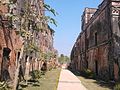 Baliati Palace
 -
 Baliati Palace
 -
 Baliati Palace - backside


- Padmar Par, Harirampur
- Teota Jamindar Bari, Shivalaya upazila
- Taota Noboratna Modh, Shibalaya
- Narayan Sadhur Asrom
- Historical Shrine and Mosque of Machaine Village
- Kabiraj Bari
- Beutha Bridge
- Betila Palace
- Betila Mondir
Subdivisions
The district's upazilas are:
- Daulatpur Upazila
- Ghior Upazila
- Harirampur Upazila
- Manikganj Sadar Upazila
- Saturia Upazila
- Singair Upazila
- Shivalaya Upazila
Education

There are 27 colleges in the district,[8] including Government Debendra College, which was founded in 1942,[1] and the private NPI University of Bangladesh, which was founded in 2016. There is one medical school: Colonel Malek Medical College.
According to Banglapedia, notable secondary schools in the district include:[1]
- Baliati Iswar Chandra High School (founded 1919)
- Bajpara High School (1995)
- Barangail Gopal Chandra High School (1924)
- Dhankora Girish Institution (1917)
- Diabari High School
- Dhulla B. M. High School (1920)
- Ghior D. N. Pilot High School (1929)
- Hatipara High School
- Ibrahimpur Iswar Chandra High School (1923)
- Jamirtta S. G. High School (1921)
- Jhitka Ananda Mohan High School (1926)
- Joymontop High School (1921)
- Kellai Monsur Uddin ML High School (1956)
- Manikganj Government High School (1884)
- Manikganj Model High School (1925)
- Muljan High School (1978)
- Nali Bararia Krishna Chandra High School (1915)
- Patgram Anath Bandhu Government High School (1915)
- Teota Academy (1891)
- Terosree K. N. Institution (1922)
- Manikganj Technical School & collage
- Ghosta DM High School
The madrasa education system includes two fazil madrasas and one kamil madrasa—Manikganj Islamia Kamil Madrasa, founded in 1953.[1][9]
The technical education system includes the Government Textile Vocational Institute Manikganj.
Notable people
- Khan Asifur Rahman Agun – singerTemplate:Citation needed
- Begum Badrunnessa Ahmed – politician and social worker, was raised by the zamindar of Paril[10]
- Naib Uddin Ahmed – photographer, was born in Paril village in 1925[11]
- Rafiq Uddin Ahmed – Bengali language movement martyr, was born in Paril village in 1926[12]
- Mir Quasem Ali – war criminal, was born in Munshidangi village in 1952[13]
- Momtaz Begum – singer and politician, was elected to Parliament from constituency Manikganj-2[14]
- Amalendu Biswas – stage actor, lived in Jabar village[15]
- Aruna Biswas – television and film actress, calls Manikganj her hometown
- ↑ 1.0 1.1 1.2 1.3 1.4 Template:Cite book
- ↑ Template:Cite book
- ↑ Bangladesh District Gazetteers:Manikganj. Government of Bangladesh. 1979, pp. 2–8
- ↑ Template:Cite book
- ↑ Census of India, 1941 Volume VI Bengal Province. Accessed 13 August 2022.}
- ↑ 6.0 6.1 6.2 6.3 Cite error: Invalid
<ref>tag; no text was provided for refs namedcensus2011 - ↑ Cite error: Invalid
<ref>tag; no text was provided for refs named2022census-district - ↑ List of Colleges, Ministry of Education, Department of Secondary and Higher Education. Accessed 21 March 2019.}
- ↑ Institute List, Ministry of Education, Bangladesh Madrasah Education Board. Accessed 21 March 2019.}
- ↑ Template:Cite book
- ↑ Template:Cite news
- ↑ Template:Cite book
- ↑ Template:Cite news
- ↑ Template:Cite news
- ↑ Template:Cite news
Pages in category "Manikgoanj District"
This category contains only the following page.